
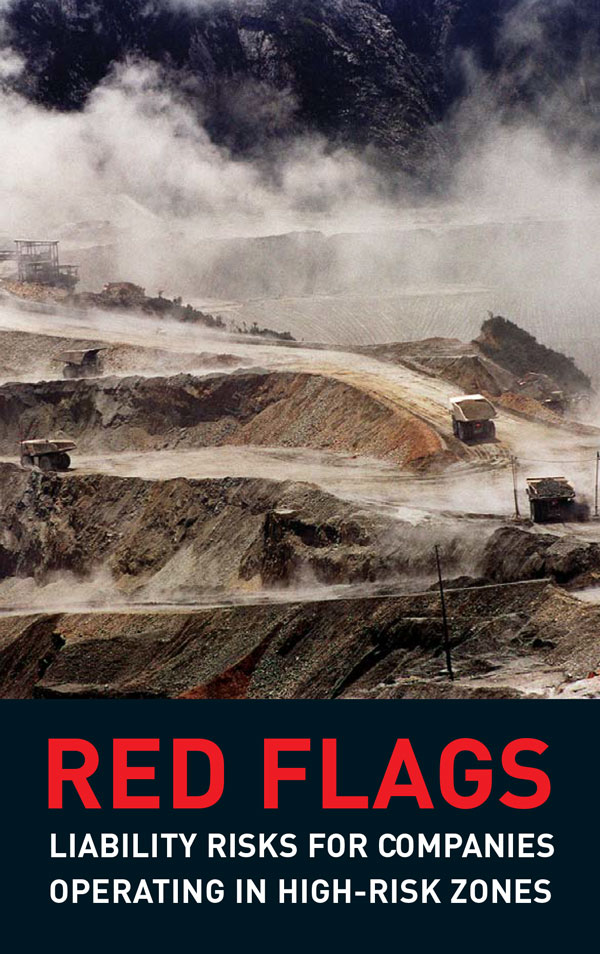
The web of liability is expanding. The legal liabilities of a company operating internationally are not limited to the domestic laws in host countries. Laws at home and in third countries may also apply. This web site lists activities which should raise a ‘red flag’ of warning to companies of possible legal risks, and the need for urgent action.
The activities identified below are drawn from a review of existing international law and court cases in more than a dozen jurisdictions. Each red flag is hyperlinked to a summary of the relevant laws and a selected case or two. Additional resources for companies, governments, affected communities and researchers can be found here as well.
1. Expelling people from their communities
The threat or use of violence to force people out of their communities can be a crime under international law. A company may face liability if it has gained access to the site on which it operates, where it builds infrastructure, or where it explores for natural resources, through forced displacement.
A Japanese company was sued in Japan for its involvement in the alleged involuntary resettlement of people in Indonesia prior to the building of a dam. The case is now awaiting appeal after a lower court rejected the plaintiffs argument on the grounds that the harm was an internal affair within Indonesia.
2. Forcing people to work
Companies using people working against their will through the threat or use of violence may face liability. The use of such labour by a joint venture partner or state security forces may also pose a liability risk.
An American oil company was sued in the United States for the alleged use of forced labour by the Burmese military prior to the construction of an oil pipeline. The company challenged the claims in court. The parties ultimately reached an out of court settlement.
3. Handling questionable assets
Receiving funds which may have been associated with criminal activities exposes companies and individuals to legal risks. Holding, managing or hiding such funds, including funneling suspicious funds into legitimate financial channels, may result in prosecution and lawsuits.
In 2005, an American bank pled guilty in a US court and paid a $16 million fine to clear up criminal charges laid in relation to suspicious transactions involving the assets of Chilean dictator Augusto Pinochet.
4. Making illicit payments
Any significant off-the-book financial transactions may create legal liabilities under laws against corruption or bribery. Charges may be brought outside the country where the transaction takes place. Even where corruption is a common occurrence, a liability risk remains.
In 2003, an American company executive was charged in the US for allegedly arranging for $78 million in kickbacks to Kazakh officials in order to obtain oil and gas contracts in Kazakhstan. The accused is challenging the charges and the case is pending.
5. Engaging abusive security forces
The use of disproportionate force by government or private security forces acting on behalf of a company can create liabilities for the company itself. These liabilities may rise even where the actions of the security forces (e.g. killing, beating, abduction, rape) were neither ordered nor intended by the company. Legal risks may be greater where security forces have a history of abusive conduct.
A US oil company operating in Nigeria was sued in a US court after government soldiers engaged to provide security to the company allegedly shot demonstrators at an off-shore oil platform they had occupied and allegedly destroyed two villages following protests. The company challenged the claims and was acquitted by a jury.
6. Trading goods in violation of international sanctions
A company may be held liable for buying, selling or transporting products, commodities or assets originating from or going to a country, group or individual under international sanctions. The most common embargo is on arms, but increasingly sanctions are imposed on specific commodities, such as diamonds, timber, and on financial assets.
A court in the Netherlands temporarily imprisoned a Dutch businessman for alleged violations of UN sanctions against Liberia by arranging for arms imports. The conviction was overturned on appeal but the high court has ordered the appeal to be heard again.
7. Providing the means to kill
Businesses may face liabilities if they provide weapons or dual-use equipment to governments or armed groups who use those products to commit atrocities. This may be the case even where import and export regulations are fully respected.
A court in the Netherlands imprisoned a Dutch businessman for providing chemical components which the Iraqi military used against Kurdish civilians in 1988. The accused challenged the allegations. On appeal, the court confirmed the conviction, increasing the sentence to 17 years.
8. Allowing use of company assets for abuses
The threat or use of violence to force people out of their communities can be a crime under international law. A company may face liability if it has gained access to the site on which it operates, where it builds infrastructure, or where it explores for natural resources, through forced displacement.
Indonesian villagers sued an American oil company in a US court, claiming they were tortured by Indonesian armed forces protecting the oil company’s facilities, and that come of the abuses took place on the company’s facilities. The company has challenged the claims. The case is pending.
9. Financing international crimes
Providing financial resources to those who commit international crimes may result in liability, if those resources substantially contribute to those crimes being committed. The risk of liability increases if the company persists in doing business with the violators, particularly once the violations are common knowledge.
A German businessmen who made contributions to the SS during World War II was convicted after the war of being an accessory to a criminal organisation. An indictment by an international tribunal is still pending against a Rwandan businessman connected to the Interahamwe during the 1994 genocide. In 2007, a US company pled guilty under US anti-terrorism laws for making a payment to a Colombian militia known to be a violent paramilitary organisation.
Additional Red Flags
Since the launch of Red Flags in May 2008, several cases have emerged confirming the significance of the original list of nine Red Flags to watch out for.
At the same time, developments since May 2008 suggest the emergence of additional liability risk and the need for a tenth Red Flag.